by Wayne Waxman &
Alison McCulloch
Published January 2022 by Lexington Books. Click to visit the book at Lexington
You can download a free Amazon Kindle sample here (just look for the “send free sample button”).
- TABLE OF CONTENTS:
• Introduction
• Part I: Democratizing Government
• Chapter 1. Going Democratic
• Chapter 2. The Democratic Ideal
• Chapter 3. Phase One: Launching Democracy
• Chapter 4. Phase Two: Democracy in Action
• Chapter 5. Phase Three: The Ruling Assembly (Demarchy)
• Chapter 6. International Democracy: Foreign Affairs and War
• Chapter 7. High Quality Information — Democracy’s Lifeblood
• Part II: Democratizing Society
• Chapter 8. The Economy
• Chapter 9. Mass Media
• Chapter 10. Politics without Politicians
• Chapter 11. Constitutional Democracy
• Chapter 12. Institutional Democracy
• Bibliography
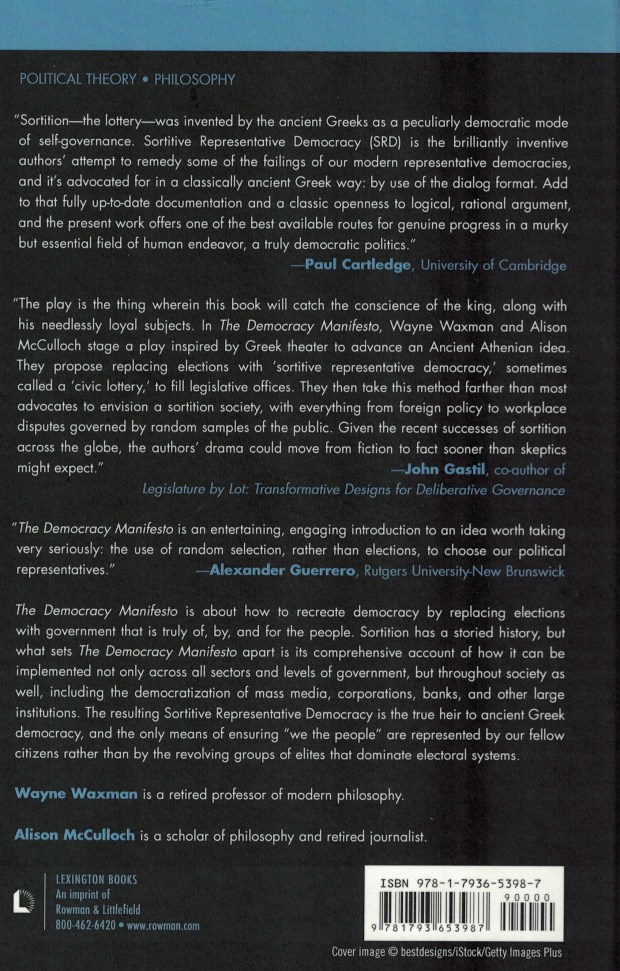
The Democracy Manifesto is about how to recreate democracy by replacing elections with government that is truly of, by, and for the people. Sortition has a storied history, but what sets The Democracy Manifesto apart is its comprehensive account of how it can be implemented not only across all sectors and levels of government, but throughout society as well, including the democratization of mass media, corporations, banks, and other large institutions. The resulting Sortitive Representative Democracy is the true heir to ancient Greek democracy, and the only means of ensuring “we the people” are represented by our fellow citizens rather than by the revolving groups of elites that dominate electoral systems.

Praise for The Democracy Manifesto
“Sortition-the lottery-was invented by the ancient Greeks as a peculiarly democratic mode of self-governance. Sortitive Representative Democracy (SRD) is the brilliantly inventive authors attempt to remedy some of the failings of our modern representative democracies, and it’s advocated for in a classically ancient Greek way: by use of the dialog format. Add to that fully up-to-date documentation and a classic openness to logical, rational argument, and the present work offers one of the best available routes for genuine progress in a murky but essential field of human endeavor, a truly democratic politics.”
Paul Cartledge, University of Cambridge
“The play is the thing wherein this book will catch the conscience of the king, along with his needlessly loyal subjects. In The Democracy Manifesto, Wayne Waxman and Alison McCulloch stage a play inspired by Greek theater to advance an Ancient Athenian idea.
They propose replacing elections with ‘sortitive representative democracy, sometimes called a ‘civic lottery,’ to fill legislative offices. They then take this method farther than most advocates to envision a sortition society, with everything from foreign policy to workplace disputes governed by random samples of the public. Given the recent successes of sortition across the globe, the authors drama could move from fiction to fact sooner than skeptics might expect.”
John Gastil, co-author of Legislature by Lot: Transformative Designs for Deliberative Governance
“The Democracy Manifesto is an entertaining, engaging introduction to an idea worth taking very seriously: the use of random selection, rather than elections, to choose our political representatives.”
Alexander Guerrero, Rutgers University-New Brunswick
Wayne Waxman: Wayne Waxman is the author of Kant’s Model of the Mind (Oxford University Press, 1991), Hume’s Theory of Consciousness (Cambridge University Press, 1994), Kant and the Empiricists: Understanding Understanding (Oxford University Press, 2005), Kant’s Anatomy of the Intelligent Mind (Oxford University Press, 2014), and A Guide to Kant’s Psychologism (Routledge, 2019), as well as numerous articles and chapters on the history of modern philosophy. He received his PhD in philosophy in 1987 from the University of California Santa Barbara, was an Alexander von Humboldt Stiftung fellow in Berlin and Oxford, and has taught philosophy at the New School for Social Research, University of Colorado Boulder, Princeton, Yale, University of Illinois Chicago, University of Auckland, and the University of Ireland at Maynooth. He is retired and living in New Zealand.
Alison McCulloch: worked as a journalist for more than 20 years, in New Zealand, France and the United States where she shared a Pulitzer Prize won by The Denver Post news staff in 2000, was a staff editor at The New York Times, and a contributor to The New York Times Book Review. She has a Ph.D. in philosophy from the University of Colorado Boulder, and is the author of Fighting to Choose: The Abortion Rights Struggle in New Zealand (Victoria University Press, 2013).
This Is Not a Democracy: Read an article by Alison about sortitive representative democracy here.
Errata:
1. p. 6 lines 4-9 should read: “Cato is conservative in favoring government that puts tradition first, Uhuru liberal for wanting government to take a leading role in replacing traditional ways and values with more modern ones, Atlas libertarian in preferring to see government minimized to the greatest extent possible, and Rangi leftist in favoring government that makes working people and the poor its priority in all things.”
2. p. 71 line 1 should read: “rich and powerful outside government”
3. p. 72 line 8 should read: “SRD imbuing government”
4. p. 72 line line 22 should read: “tends to be the case with government advising today”
5. p. 95 line 35 should read: “certain SRD information protocols extended beyond government,”
6. p. 104, 4th line from bottom should read: “money would end up going to government, not”
7. p. 139 line 12 should read: “The process leading to that point starts with ideas people like me.”
8. p. 144 line 5 should read: prisoners and probationers.
Thank you for your response. ✨

There are more idols in the world than realities.
Friedrich Nietzsche, Twilight of the Idols
 Anonymous
  WayneWax
  The Democracy Manifesto
Leave a comment